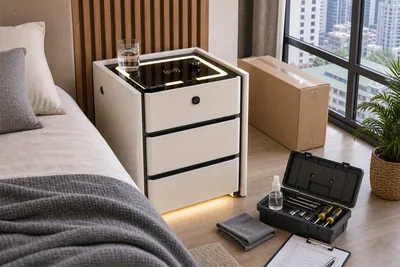
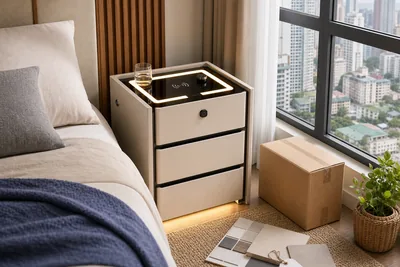
A bedside table can fit between the bed and wall while offering too little useful surface for daily life. The lamp takes most of the top, the phone rests against its base, and a water glass ends up close to the edge. For Philippine condo buyers and bedroom furniture dealers, usable top space is a more helpful question than whether a cabinet looks compact in a photograph.
Start with the objects that will actually be used. The method below turns them into a simple layout test that can be repeated on a showroom sample or with a paper template at home. It does not prescribe one cabinet size for every condo: room layouts, bed frames and personal routines differ.
Measure the surface that can hold objects
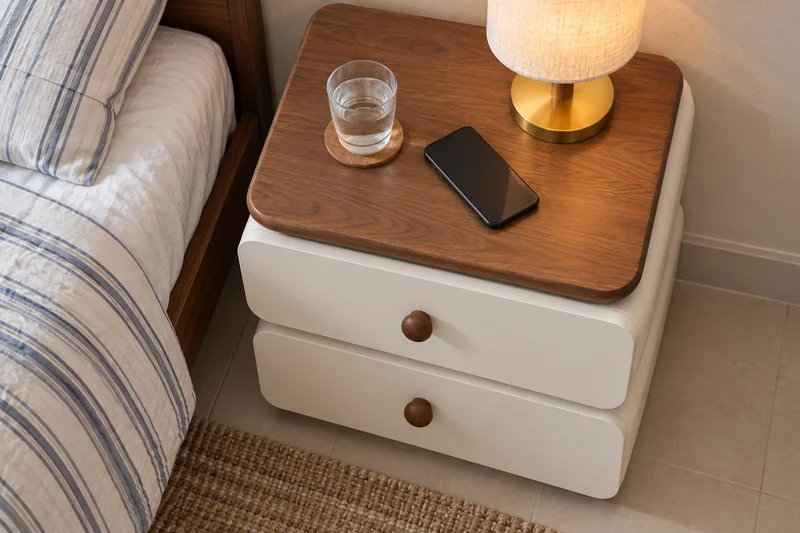
Record the cabinet's assembled width and depth, then inspect its top. Raised edges, a curved outline, a built-in control area or an overhanging decorative panel can change the space available for a lamp. The widest point of the cabinet is not necessarily the width of a flat, usable rectangle. Ask for a top-view photograph if the product page only shows a front view.
Measure the lamp base rather than estimating from the shade. Add the phone with its normal case, the intended coaster and any book or glasses. If a charging module is integrated into the cabinet, treat its required placement area as occupied space. Do not put a lamp over it simply because the top appears clear when the phone is absent.
Make a full-size paper layout
Mark the usable top outline on paper and place the actual objects inside it. For example, a hypothetical 40 by 40 cm top may feel very different with a 12 cm lamp base than with a 22 cm base. Those figures illustrate the method; they are not a specification for the pictured cabinet. The remaining space also needs to be accessible from the bed, not merely visible on the plan.
Try removing and replacing the phone without shifting the lamp. Pick up the empty glass and put it down again. Check whether a charging lead drags across the coaster or whether the lamp switch is hidden behind another object. This small exercise often identifies a better lamp choice before a larger cabinet becomes necessary.
Give each object a stable position
Put the lamp where its base sits fully supported and its switch can be reached. Keep the phone in a position that does not require a cable to cross the drawer opening. A water glass should have a stable resting area away from powered components and from the edge. Use the furniture and electrical manufacturers' instructions when deciding what may be placed near charging equipment.
Do not interpret a styled photograph as proof of water resistance. A coated or upholstered cabinet may still need spills wiped promptly, and the appropriate cleaning method depends on its actual materials. The article on finishes and reorder planning for Philippine condos provides the complementary questions to ask about surfaces and edges.
Check reach from the bed, not only from above
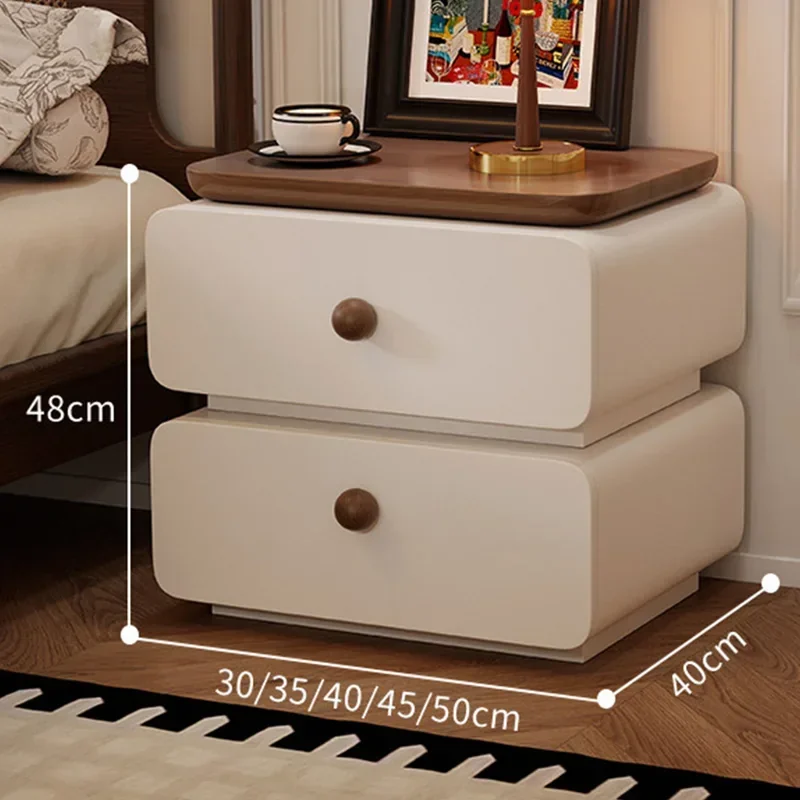
A top-view plan can look tidy while placing the phone too far away. Position the sample at its intended height beside the mattress and test from the pillow position. The user should be able to reach everyday objects comfortably without knocking the lamp. A deep upholstered bed rail can move the cabinet farther from the mattress than a showroom photograph suggests.
Also test the drawer. If the cabinet must move forward to clear the bed frame, repeat the top-space and cable checks in that position. A narrow cabinet is not an advantage if every evening involves moving it around. For a shared bedroom, evaluate each side independently; the wall socket and walking route may differ.
Clear the top by choosing appropriate storage
Some objects do not need to stay on the surface. A spare cable, notebook or glasses case may fit better inside a drawer, provided the opening and interior dimensions are suitable. Measure the actual compartment rather than assuming that a large front means a deep drawer. Avoid stuffing powered adapters or charging devices into closed storage unless their instructions explicitly permit that use.
For rental units, consistent storage positions can also simplify handover and checks between occupants. Our guide to bedside table maintenance after bulk delivery explains how a short furniture record helps operators identify the supplied model and handle later issues. Top-space planning can become part of that same record.
What dealers should show in product photographs
Include one honest top view and one image from bed height. Use ordinary-size objects and identify the cabinet dimensions in the product information rather than adding misleading scale marks to a generated image. Avoid very small props that make the top look larger. A photo showing the whole lamp base is more informative than one where the shade conceals half the furniture.
For furnished-condo programmes, compare the proposed bedside tables for condos and accommodation with the intended lamps before confirming quantities. Send the lamp-base dimensions, bed height and desired storage items with the enquiry. If the cabinet has optional electronics, list those separately so the supplier can confirm the actual arrangement.
The final test is simple: use the bed, reach the phone, operate the lamp, open the drawer and clean the top. If these actions work without moving several objects first, the surface is doing its job. That is a more durable reason to choose a bedside table than how spacious it appears in an empty-room photograph.